Setting the Table: Why Community Makes a Difference for Your Health
STORY
Setting the Table: Why Community Makes a Difference for Your Health
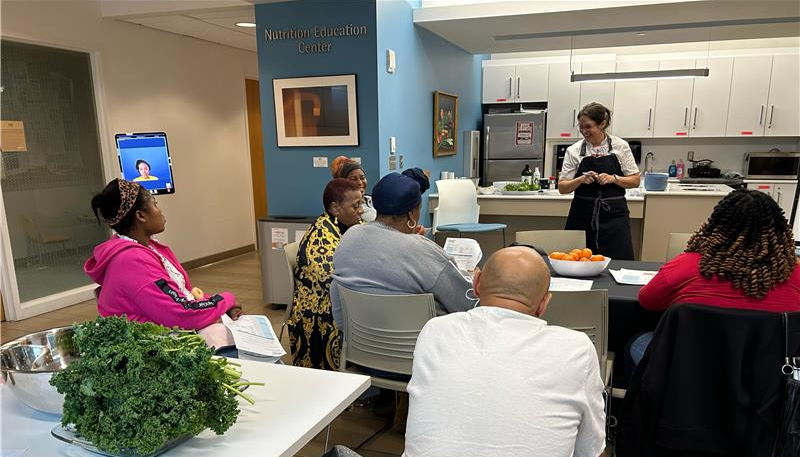
The scent of fresh herbs and lemon fills the bright, modern teaching kitchen on the second floor of the Mattapan Community Health Center. Behind the counter, culinary dietitian Christina Vollbrecht, MA, MS, RDN, LDN, arranges her ingredients—salmon, kale, barley, and a mix of warm spices—for tonight’s class, “Balance: All About Lipids.”
Soon, nine community members will gather around the tables to chop, stir, and learn together. Tonight’s menu pairs heart-healthy ingredients with lessons on how small, sustainable changes can make a big difference in long-term heart health.
This class is part of HEART of Communities, a six-month program that helps people living with diabetes, high blood pressure, and obesity take charge of their heart and metabolic health.
This groundbreaking collaboration between Boston Medical Center, Mass General Brigham, and Mattapan Community Health Center brings care directly into surrounding Boston neighborhoods, providing hands-on education, nutrition guidance, and medical support that make healthcare more accessible and more personalized than ever before.
Understanding All the Ingredients
Tonight is not your traditional cooking class. Education comes first, then cooking. Each ingredient and method comes with a purpose. Each recipe is designed with accessibility in mind, using ingredients that are easy to find and affordable within the community.
“Patients need to understand the disease process first,” says Gertha Dabady, DNP, Community Health Nurse Practitioner. “They need to know what they’re facing so they’re prepared to self-manage their care.”
This balance of learning and doing is what defines HEART of Communities. Tonight’s cooking class reflects the core experience this six-month program has to offer. Rooted in community and care, the initiative combines personalized healthcare with weekly group sessions focused on building healthier habits. Along the way, patients receive medical guidance, one-on-one support from community wellness advocates, and practical tools—like glucose monitors and blood pressure cuffs—to help them make lasting changes.
Meeting Patients Where They Are
Daisy King, affectionately referred to as “Miss Daisy,” is the first to arrive for tonight’s class. She knows everyone, and everyone knows her.
“I've been a patient at Mattapan Health Center for 33 years,” she proudly shares. “My doctors know I dealt with high blood pressure and a high sugar count. They asked if I would like to participate in the program, and I’ve been here four, maybe five months now.”
Miss Daisy is one of many patients who’ve experienced real change through the program. Each participant brings a unique story, but they all share one important thing—they call this community home.
“I live less than five minutes away,” shares Tricia Miller. “That’s why I joined. We didn’t have programs like this before. Sometimes the community has felt forgotten, but not with this program. I leave work early to be here and participate and improve myself.”
Mattapan is a diverse neighborhood less than 10 miles south of downtown Boston. The patients in attendance this evening are a perfect reflection of their community, each bringing a unique culture and history to the table.
One patient sits in the back of the class. On her right sits her young daughter, equipped with a set of crayons given to her by Natalie DeLaCruz, Community Wellness Advocate. On the patient’s left, an iPad fixed to a mobile Propio One interpreter cart broadcasts a real-time translation in Haitian Creole.
Christina, in her white chef’s apron, is currently at the whiteboard, marking out the distinct differences between types of fats and their impact. In a seamless teaching rhythm, she gives space for her sentences to land in English and then again in Haitian Creole.
Anaëlle Séïde, MPH, Community Health Equity Manager, adds, “We have to know the community we’re serving. It’s diverse, and interpreter services are essential. Without it, we’d miss the point.”
Seeing the Impact: Why Patients Come Back
In conversation with each of these patients, one thing becomes clear: while the courses are impactful, it’s the people who make the greatest difference.
“Me and Natalie—she's like one of my children now,” Miss Daisy beams. "She calls twice a week. If it's something we talked about, she checks in to make sure it's taken care of. She's helped me with a lot, not only health. She gives me advice and connects me with people who can help.”
“Cooking is hard. Sitting down to enjoy something you made is an accomplishment. That shared meal becomes a way to digest the food, the information, and feel human—just for a little while. That’s why we do it.”
— culinary dietitian Christina Vollbrecht, MA, MS, RDN, LDN
Every person in the room has seen a physical difference. Each has shared stories of weight loss, improved energy, or lower blood sugar levels. The impact is more than just clinical. It’s personal and empowering.
Tricia admits her early hesitancy to join the program. But a combination of health scares and a conversation with Gertha changed her mind about the whole experience.
“Because of my culture, I didn’t think a nutritionist would understand my food. Gertha assured me this would be different, that every person is different, and it’s not a ‘one-size-fits-all.’ I’d never worked with a nutritionist until now.”
For Sheilla Buon—one of the program’s first graduates—the results spoke for themselves.
“I got a report today that my A1C went down from 12 to 6.6. My cholesterol went from 140 to 122. I know it's working,” shares Sheilla, who has since encouraged her husband to join the program as well. “If you’re serious about changing how you live—join. If your goal is to be there for your spouse or kids—join. Whether you go alone or with a friend, you’ll take something away from it and be better for your family.”
A Program Shaped by the Community
In the adjoining room, the dynamic HEART of Communities team—nurse practitioners, community wellness advocates, dietitians, and other specialists—prepares for tonight’s next educational course. They are also discussing a milestone worth celebrating—their first graduating class.
These early patients shaped the program with their feedback, from requesting binders to recommending more community outings. Their voices helped mold what the program is today.
This is health equity in action. It is a program designed with, not just for, the community. The result is a program that not only teaches healthier habits but also builds community trust into every step of care.
HEART of Communities offers a blueprint for what’s possible when care becomes rooted in a community. Officially launched in March 2025, this team began with 45 patients. Today, just eight months later, the program has tripled to 150 patients.
“That was always the goal—to scale as fast as we possibly could,” Giavanna Gaskin, MBA, Director of Health Equity Programs. “Our goal is to serve 480 patients a year, 240 patients at any given time. We hope to expand to other neighborhoods in the future.”
A Meal with Meaning
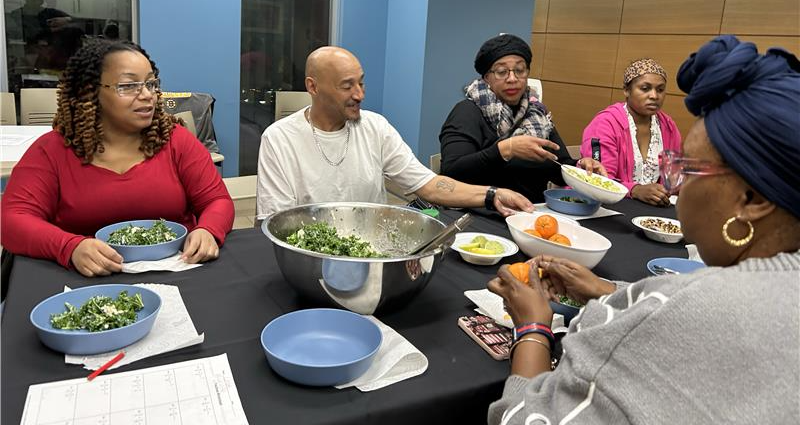
To close the evening, all nine class members gather around the table, sharing the kale and barley salad and salmon cakes they prepared together. As they pass dishes and stories, they reflect on what they’ve learned and how they’ll bring it home.
“Cooking is hard. Sitting down to enjoy something you made is an accomplishment,” Christina proudly states. “That shared meal becomes a way to digest the food, the information, and feel human—just for a little while. That’s why we do it.”
About HEART of Communities
HEART of Communities is more than a program—it’s a commitment to better health in Mattapan. Explore the work behind this first-of-its-kind collaboration.